


Self Improvement Month: Your Evening Routine Guide
You've already tried the productive morning. You journaled, exercised, mapped out your priorities, and promised yourself a calmer day. Then night arrived, your phone stayed in your hand, your thoughts started racing, and bedtime drifted later than planned. You woke tired and wondered why your self improvement month wasn't changing anything.
The answer usually isn't another morning goal. It's the 90 minutes before sleep. That window determines whether your body can recover, your mind can settle, and tomorrow's habits have a realistic chance of sticking. Self Improvement Month is recognized as an annual September observance, with the 2026 observance beginning on September 1, 2026, and historical summaries tracing its wider national momentum to the 1980s, including 1988 as a more formalized nationwide observance year. National Today's history of Self-Improvement Month provides that background.
Use this month to build one evening system, not a longer list of intentions. The system below centers on four practical pillars: a shower steamer ritual that cues wind down, breathing drills that help shift your body toward rest, light and phone hygiene that protect your sleep signals, and a fixed 90-minute start trigger. For broader ideas on natural sleep habits, AloeCure's natural sleep habits offers useful context. You can also explore these self-improvement tips for Self Improvement Month, but keep your focus narrow. Inspiration won't carry a routine that has no trigger.
Table of Contents
- Why Your Evening Routine Anchors Self Improvement Month
- The Shower Steamer Ritual That Signals Wind Down
- Breathing Exercises to Drop Into Sleep Mode
- Light and Phone Hygiene Before Bed
- Timing Your 90 Minute Pre Sleep Window
- Common Mistakes That Break the Routine in Week One
- Your First Week Starter Challenge
Why Your Evening Routine Anchors Self Improvement Month
The evening wind-down window is the key point of Self Improvement Month because it sets the conditions for everything that follows. A morning workout feels harder after a restless night. Journaling becomes another obligation when your mind is already overloaded. Even a carefully planned day starts with a disadvantage when late scrolling and unfinished thoughts keep your nervous system alert.
Your evening routine doesn't need to feel luxurious or complicated. It needs to be predictable enough that your body recognizes it. Repeating the same sequence gives your brain fewer decisions to make and creates a clear boundary between solving the day and ending it.
Practical rule: Build the routine for the version of you who's tired, distracted, and looking for an excuse.
Start with one reliable sequence
Use the same order each night:
- Begin the wind-down trigger. Start 90 minutes before your intended lights-out time.
- Take the shower. Use the sensory ritual as the first physical signal that the day is ending.
- Practice one breathing drill. Choose the technique that matches your mental state.
- Remove bright light and phone stimulation. Make the bedroom boring in the best possible way.
- Enter bed only for sleep. Don't turn the final part of the routine into another planning session.
This approach is more useful than collecting dozens of goals because it gives you a repeatable behavior chain. The broader self-improvement industry also shows that consumers respond strongly to practical personal development content. A 2026 industry summary places the U.S. self-improvement market at about $12 billion in 2024 and the global personal development market at about $51 billion in 2025. It also reports that self-help print sales rose 14.7% in 2025, while the overall book market was nearly flat at 0.3% growth, as described in this self-improvement industry summary. The demand is real, but consuming more advice won't replace a routine you repeat.
Treat the first month as a setup and stabilization phase, not a finish line. A 2024 systematic review and meta-analysis of 20 studies involving 2,601 participants found that health-related habits commonly take about 2 to 5 months to form, with median times of 59 to 66 days and substantial variation from 4 to 335 days. The systematic review and meta-analysis supports a simple conclusion: month one should make the routine easy to repeat, not force you to escalate it quickly.
The Shower Steamer Ritual That Signals Wind Down
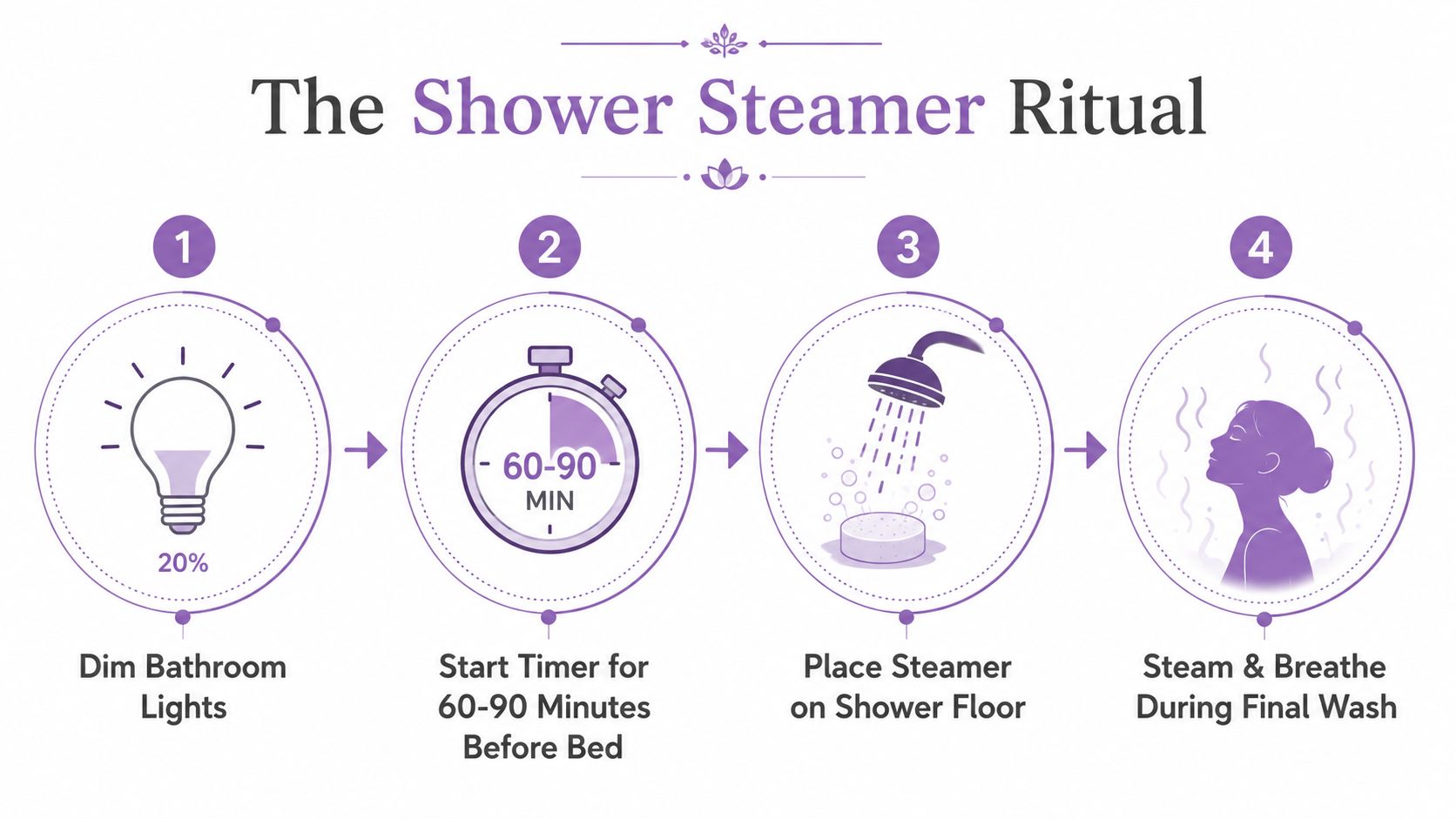
Use the shower as the first anchor because it gives you a clear physical transition. Start the ritual 60 to 90 minutes before lights out, not when you're already in bed trying to force sleep.
Set up the room before you enter
Dim the bathroom lights first. If you can, use one softer lamp instead of bright overhead LEDs. Place one shower steamer on the floor, away from the direct stream, where water can reach it gradually rather than dissolve it immediately. Lavender or eucalyptus scents fit an evening ritual, while the best choice is the scent you'll consistently associate with winding down.
Run the hot water for several minutes before stepping in. Let the room become comfortably steamy, then lower the temperature to warm rather than scorching. A shower lasting roughly 8 to 12 minutes is enough for a consistent ritual. You're not trying to create a demanding spa treatment. You're creating a repeatable cue.
Let the shower remain stimulus-free
Leave your phone outside the bathroom. Don't rehearse tomorrow's presentation, answer messages, or mentally solve a disagreement while the water runs. Give your attention one uncomplicated job: notice the warmth, the steam, and the scent.
The ritual works through repetition. When the same scent, lighting, water, and sequence occur before bed, your brain can begin treating those signals as preparation for rest. The shower doesn't need to “knock you out.” It needs to become the dependable first step that starts the rest of the routine.
For detailed placement and usage guidance, read how to use shower steamers. If you're choosing a product for a different part of the day, the Cleverfy Energy Boost Megapack of 18 Shower Steamers contains ginger and orange, grapefruit, and cocoa and orange scents, and is described for morning showers. For an evening-specific option, choose a lavender-based steamer instead.
When the shower ends, don't check email. Towel off, reduce the household lighting, and move directly to breathing. That immediate transition matters because every extra decision creates an opportunity to restart the day.
Breathing Exercises to Drop Into Sleep Mode
Breathing drills give your routine a simple action to perform when your mind refuses to settle. Choose based on the kind of evening you're having, and practice the same drill often enough that you don't need to remember instructions while tired.
For racing thoughts
Use 4-7-8 breathing:
- Inhale: Breathe through your nose for 4 counts.
- Hold: Keep the breath for 7 counts.
- Exhale: Breathe slowly through your mouth for 8 counts.
- Repeat: Complete 4 full cycles.
The long exhale gives your attention a narrow target and makes mental rehearsal harder to sustain. If holding your breath feels uncomfortable, stop and return to natural breathing rather than forcing the count.
For general wind down
Use box breathing when you feel alert but not overwhelmed:
- Inhale for 4 counts.
- Hold for 4 counts.
- Exhale for 4 counts.
- Hold for 4 counts.
- Repeat for 4 to 6 rounds.
For a stressful day, try a physiological sigh. Take two short inhales through your nose, followed by one long exhale through your mouth. Repeat 5 to 8 times, then sit for a moment. The extended exhale can help shift your body toward a calmer rest-and-digest state.
Run the drill after the shower, either on the bathroom floor or in bed. This guide to creating an effective sleep routine can help you place breathing within a broader sequence, but don't add techniques just to make the routine look complete. One drill performed consistently beats three drills you keep forgetting.
Light and Phone Hygiene Before Bed
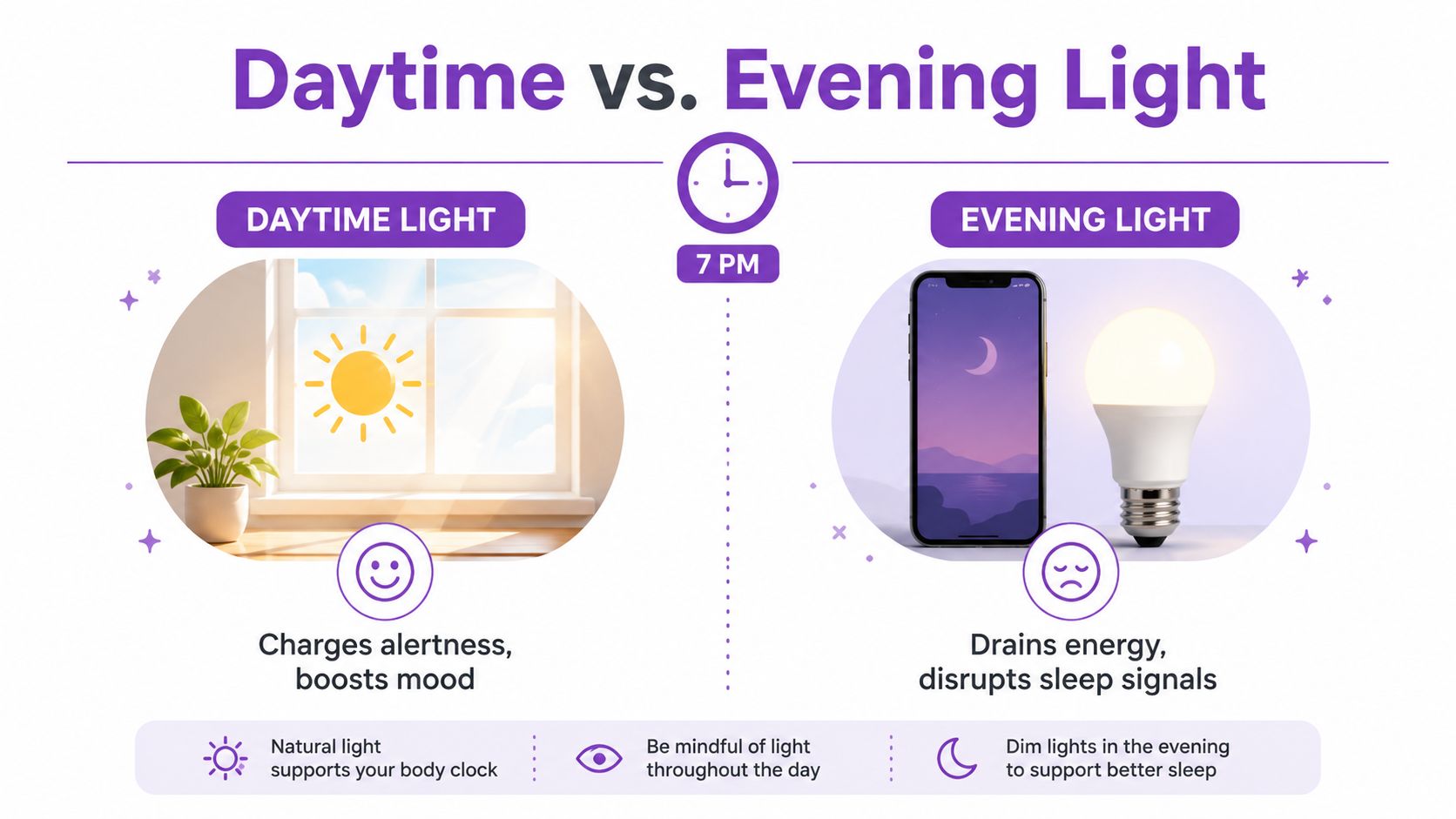
Morning light helps you feel oriented toward the day. Evening light tells your brain that stimulation is still available, especially when it comes from bright LEDs, a glowing phone, or a bathroom vanity mirror. Treat the final hours before bed as a gradual reduction in alerting input, not as a time to squeeze in more entertainment.
Start by lowering overhead lights to their warmest, dimmest setting during the last part of the evening. Replace cool bulbs where practical with warmer lighting, and use a single lamp in the bathroom instead of the full vanity strip. Your goal is simple: dim, warm, and visually quiet.
Make the phone inconvenient
Don't rely on willpower while lying in bed. Park the phone outside the bedroom, or place it face-down across the room. Disable push notifications so your wind-down isn't interrupted by messages that can wait until morning.
Replace scrolling with something that has a natural stopping point:
- Printed reading: Choose a physical book or magazine instead of an endless feed.
- Gentle mobility: Stretch slowly for a few minutes without turning it into a workout.
- Quiet preparation: Set out tomorrow's clothes before the final bedroom block begins.
If you must use a screen, activate the strongest warm or amber filter available and keep the session brief. Don't use a filter as permission to scroll indefinitely. The behavior that disrupts your routine is often the open-ended session, not only the color of the display.
People who want more specialized information can review this discussion of prescription blue light glasses effectiveness. Glasses may be one consideration, but they shouldn't replace dim lighting, notification control, and a firm phone cutoff.
Timing Your 90 Minute Pre Sleep Window
A beautifully designed routine fails if you start it too late. Timing is the most critical variable because it determines whether every step has room to happen without pushing bedtime later.
Pick one bedtime and work backward. Write the start trigger on a note beside the bathroom mirror. When that trigger arrives, the shower starts, the phone goes dark, and nonessential tasks wait until the next day.
Divide the window into three blocks
The first 30 minutes belong to the shower and hygiene. Dim the room, place the steamer, shower, dry off, brush your teeth, and lower the lights throughout the home.
The middle 30 minutes belong to breathing and gentle mobility. Sit or lie on the floor, run your chosen breathing drill, and stretch without checking messages or adding a workout goal.
The final 30 minutes belong to bed. Don't use this block for problem-solving, music discovery, online shopping, or tomorrow's planning. If reading helps you settle, choose it before the final transition or keep the material familiar and low-stimulation.
You can use a tool to calculate sleep cycles, but don't let sleep-cycle estimates become another source of optimization anxiety. A stable start trigger matters more than finding a perfect bedtime formula.
If the routine keeps ending too late, adjust the trigger by 15 minutes during the first week until it matches your actual bedtime. Once it works, stop tinkering. The brain learns a start cue through repetition, not constant redesign.
Common Mistakes That Break the Routine in Week One
You don't abandon an evening routine because you lack discipline. You abandon it because every step depends on remembering, negotiating, and feeling motivated at the exact moment you're exhausted.
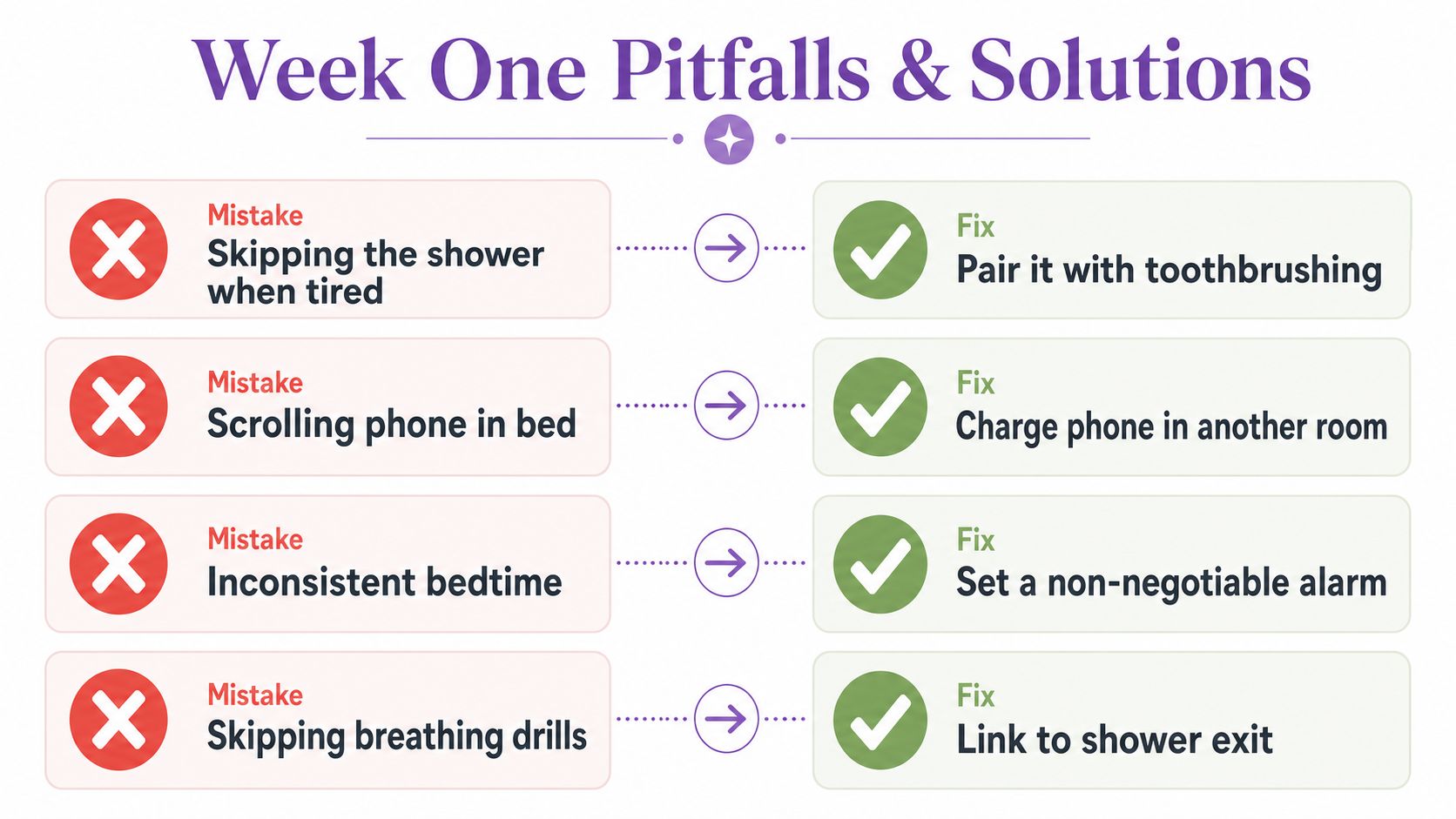
Convert predictable failures into rules
| Common failure | If-then fix |
|---|---|
| Skipping the shower when tired | If you brush your teeth, then you start the shower immediately. |
| Scrolling in bed | If you enter the bedroom, then your phone stays charging elsewhere. |
| Changing bedtime nightly | If the start alarm rings, then nonessential tasks stop. |
| Forgetting breathing drills | If you step out of the shower, then you begin the selected cadence. |
Don't overhaul every pillar at once if that makes the routine fragile. Start with one behavior and add the next only after the first feels dependable. A one-pillar week may look less ambitious, but it produces better information about what you can sustain.
Longitudinal habit research shows that habit strength increases substantially over roughly three months when people perform the desired behavior consistently, and it emphasizes that repetition quality matters as much as repetition count. This Frontiers in Psychology study on habit formation supports a minimum viable routine that can survive low-energy days.
Design the routine for your worst ordinary night, not your most motivated night.
A lapse doesn't erase the work. Record what happened, identify the broken cue, and restore the next scheduled evening. Don't respond to one missed night by making the routine longer or stricter. Make the environment do more of the work.
Your First Week Starter Challenge
Self Improvement Month should produce a routine you can carry beyond September. The evening sequence gives you a practical foundation: the shower steamer signals transition, breathing reduces mental momentum, light hygiene removes stimulation, and the 90-minute window gives each step a place.
Use this seven-day challenge:
- Night 1: Practice the phone cutoff and one breathing drill.
- Night 2: Repeat the phone cutoff and breathing drill, then note what interrupted you.
- Night 3: Complete the full routine, including the shower steamer ritual, breathing, dim lighting, and the 90-minute window.
- Night 4: Return to the breathing drill and phone cutoff only.
- Night 5: Complete the full routine again.
- Night 6: Use the shorter version, focusing on the breath and phone cutoff.
- Night 7: Complete the full routine and review the week.
Track one clear outcome each morning. Write one sentence about your energy and mood, and record whether you fell asleep within your usual short window or woke naturally before your alarm. Don't turn the log into another journal assignment. You're looking for a pattern, not a perfect score.
At the end of the week, keep the elements that made the routine easier and revise the ones that created friction. If the shower helped you start, keep it. If box breathing felt mechanical but the physiological sigh calmed you faster, use the latter. Your goal is a routine that works in real life.
The evidence on habit formation makes a 30-day completion mindset too simplistic. Automaticity often develops well after the first month, so use Self Improvement Month to establish the cue, protect the sequence, and repeat it without demanding instant transformation.
Finally, attach the evening routine to one existing morning habit. After you make coffee, drink water. After you wake up, open the curtains. After your first bathroom visit, write your one-line energy note. Give tomorrow one small action that begins because tonight ended well.
Cleverfy Beauty offers aromatherapy shower steamer tablets designed to dissolve on the shower floor and release essential-oil aromas during a regular shower. Visit Cleverfy Beauty to choose a shower-based option that fits your wind-down routine and make the first step easier to repeat.

