

Emotional Wellbeing: A Practical Guide for Real Life
You finish the workday, answer the messages, make dinner, and handle the small tasks that keep life moving. Nothing went dramatically wrong, yet you feel flat, tense, or strangely far away from yourself. That experience doesn't mean you're ungrateful or failing at self-care. It may mean your emotional wellbeing needs attention in the same practical way your sleep, nutrition, or physical fitness does.
Emotional wellbeing isn't a spa-day luxury or a demand to feel cheerful all the time. It describes how you handle ordinary pressure, experience emotions, recover from setbacks, and stay connected to people who matter. This guide turns that broad idea into small routines you can use in real life, including a five-minute shower ritual, while also covering loneliness, thoughtful wellness gifts, and the point when self-care should make room for professional support.
Table of Contents
- Why Emotional Wellbeing Matters More Than You Think
- What Emotional Wellbeing Really Means
- Signs Your Emotional Wellbeing Needs Attention
- Five Research-Backed Habits That Support Emotional Wellbeing
- Daily Routines and a Five-Minute Shower Ritual
- Choosing a Wellness Gift That Actually Lands
- When Self-Care Is Not Enough
Why Emotional Wellbeing Matters More Than You Think
A busy day can hide emotional strain. You might complete your tasks, stay polite in meetings, and keep promises to your family while holding onto irritability, worry, or exhaustion. Because you're still functioning, it's easy to dismiss those signals until they begin affecting sleep, concentration, relationships, or the ability to enjoy anything.
Global data shows why emotional wellbeing deserves more than occasional attention. In Gallup's 2024 Global Emotions findings, 39% of adults worldwide reported a lot of worry the previous day and 37% reported a lot of stress. At the same time, 73% said they smiled or laughed a lot, 73% experienced a lot of enjoyment, and 72% felt well-rested. Wellbeing can hold positive and difficult experiences at once.
Practical rule: Feeling good sometimes doesn't cancel out feeling overwhelmed at other times.
Gallup has tracked these emotional indicators since 2006, so emotional states can be compared across countries and over time rather than treated as vague personal impressions. That makes emotional wellbeing a measurable part of health, not just a phrase from the wellness industry.
You don't need to redesign your life to support it. You need a way to notice what's happening, choose a small response, and recognize when a recurring pattern calls for more help. The payoff is simple: you'll have practical signals and routines you can use before stress becomes the only thing you notice.
What Emotional Wellbeing Really Means
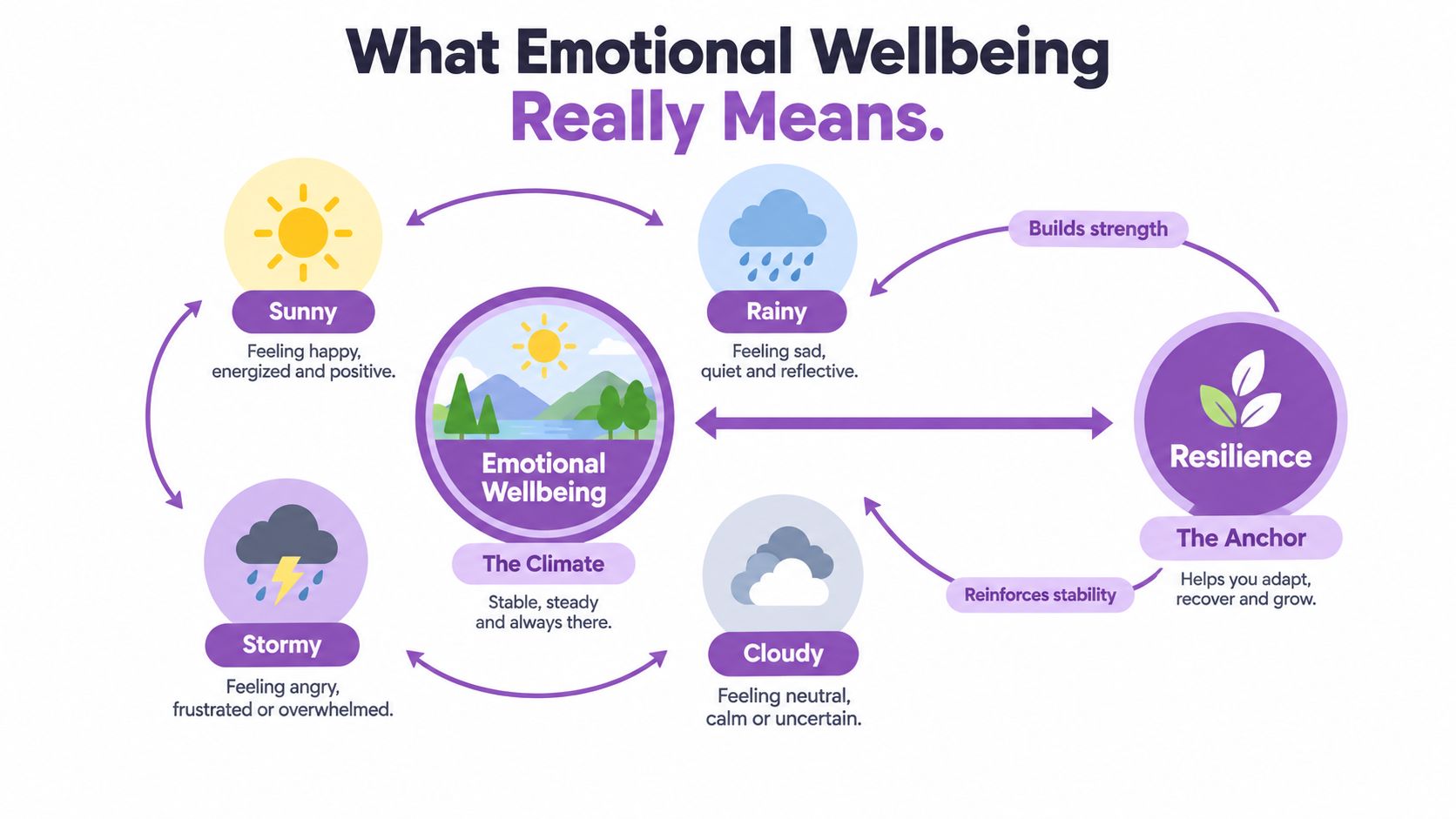
Think of mood as weather and emotional wellbeing as climate. A rainy afternoon, a stormy morning, or a cloudy week doesn't automatically mean your climate is unhealthy. In the same way, sadness, frustration, or anxiety can appear in a person with strong emotional wellbeing.
The aim isn't constant happiness. It's the ability to experience changing emotional weather without losing your sense of direction.
Three parts you can recognize
First, emotional wellbeing involves managing everyday stress. That doesn't mean staying calm in every difficult moment. It may look like taking a pause after a tense meeting, naming what upset you, and deciding what action is needed instead of reacting immediately.
Second, it includes the ability to feel and process a full range of emotions. Someone with healthy wellbeing can feel disappointed without treating disappointment as proof that everything is hopeless. They can enjoy a hobby during a demanding week, grieve a loss, or admit fear without judging themselves for having the emotion.
Third, wellbeing depends partly on satisfying relationships. Connection isn't measured only by how many people you know. It also involves whether you can ask for support, set boundaries, share ordinary moments, and feel understood by at least some people in your life.
The World Health Organization published the WHO-5 Well-Being Index in 1998, a five-item self-report tool that asks people to rate statements about their wellbeing over the previous two weeks on a six-point scale. Higher scores indicate better mental wellbeing, as described in the WHO-5 publication. Its continued use shows that emotional wellbeing can be assessed consistently, even though no questionnaire can capture your entire experience.
Good emotional wellbeing therefore looks behavioral, not perfect. You recover after a hard conversation, notice when you need rest, continue meaningful activities, and reach toward people rather than disappearing whenever life becomes difficult.
Signs Your Emotional Wellbeing Needs Attention
You snap at a harmless question, stop anticipating activities you usually enjoy, or keep scrolling because quiet feels uncomfortable. These small shifts can be early signals that your emotional resources are running low. One change alone does not diagnose a problem, but a pattern that persists or returns deserves attention.
Emotional signals
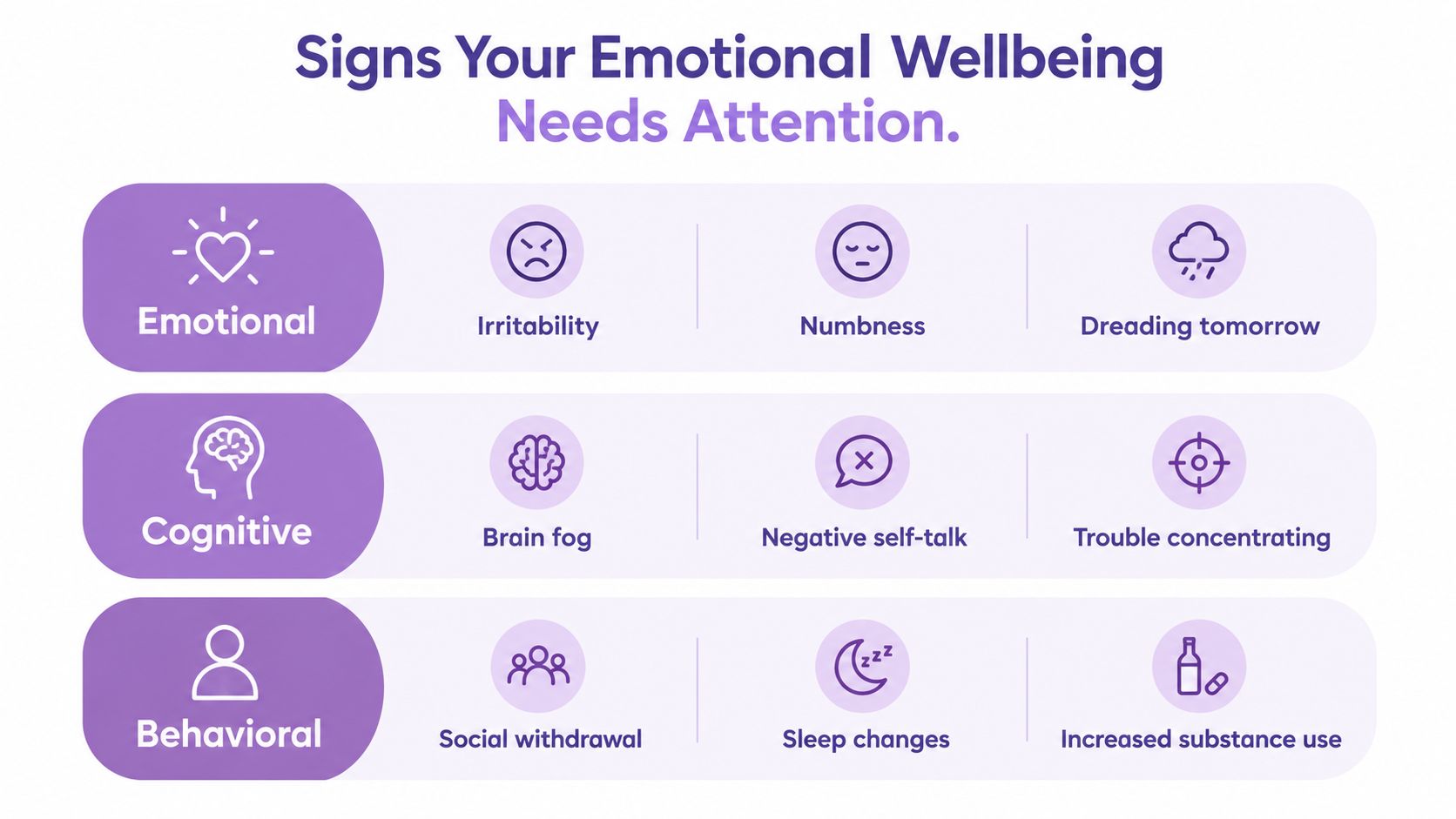
Look for irritability over small things, emotional numbness, or a steady sense of dread about the next day. You may feel unusually tearful, impatient, detached, or unable to enjoy familiar activities. Stress can cause these reactions temporarily. They deserve closer attention when rest and recovery do not ease them.
Physical and cognitive signals
The body may register strain before you can explain it. Poor sleep, persistent fatigue, headaches, muscle tension, or appetite changes can signal that your current demands are outpacing your recovery.
Cognitive changes may show up as brain fog, harsh self-criticism, or difficulty concentrating on manageable tasks. Reading the same message several times or struggling with simple decisions is useful information, not a character flaw.
Behavioral signals
Your actions can make the pattern easier to see. You might withdraw from friends, skip meals, abandon familiar routines, avoid responsibilities, or scroll late into the night. Increased substance use and constant distraction also deserve an honest look. Loneliness can reinforce these habits, because pulling away reduces the contact that might otherwise provide perspective and support.
These signs occur on a spectrum. The Wellcome Global Monitor 2022 report reports that about one in five people worldwide have experienced anxiety or depression severe enough to stop normal daily activities for two weeks or longer. Recognizing a warning sign does not make you weak or unusual.
A weekly self-check can remain simple:
- Name the pattern: Which emotion has appeared most often?
- Notice the body: What has changed in your sleep, energy, appetite, or tension?
- Check behavior: Are you moving toward people and routines, or away from them?
- Choose one response: What small action could support you today?
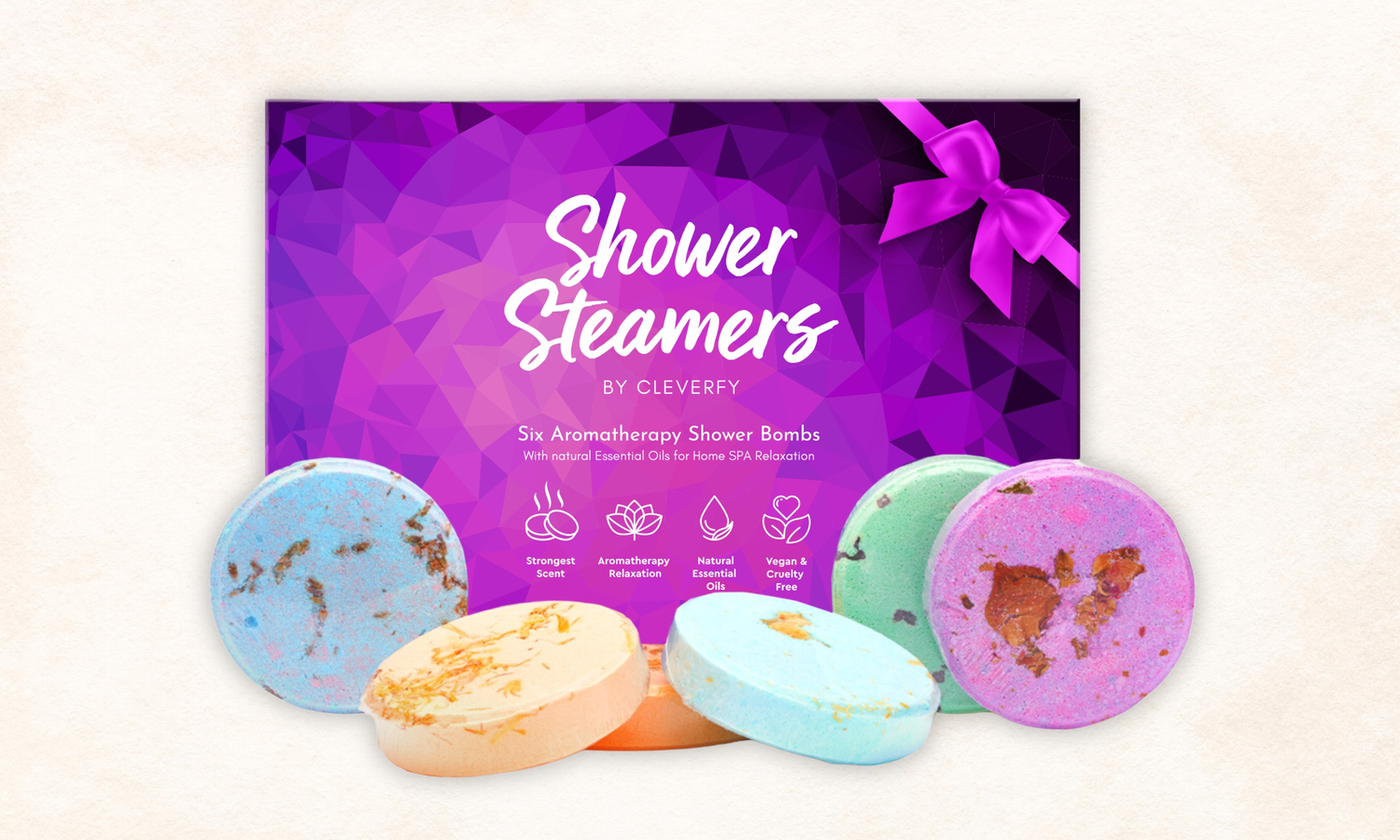
If the pattern persists, feels confusing, or disrupts daily life, exploring mental health care from Empire Medical can help clarify your options. A concrete morning cue might be a five-minute shower ritual. Cleverfy Energy Boost Megapack of 18 Shower Steamers contains ginger and orange, grapefruit, and cocoa and orange scents, with tablets designed for morning showers. Use the routine as a prompt to notice how you feel, not as a substitute for support.
Five Research-Backed Habits That Support Emotional Wellbeing
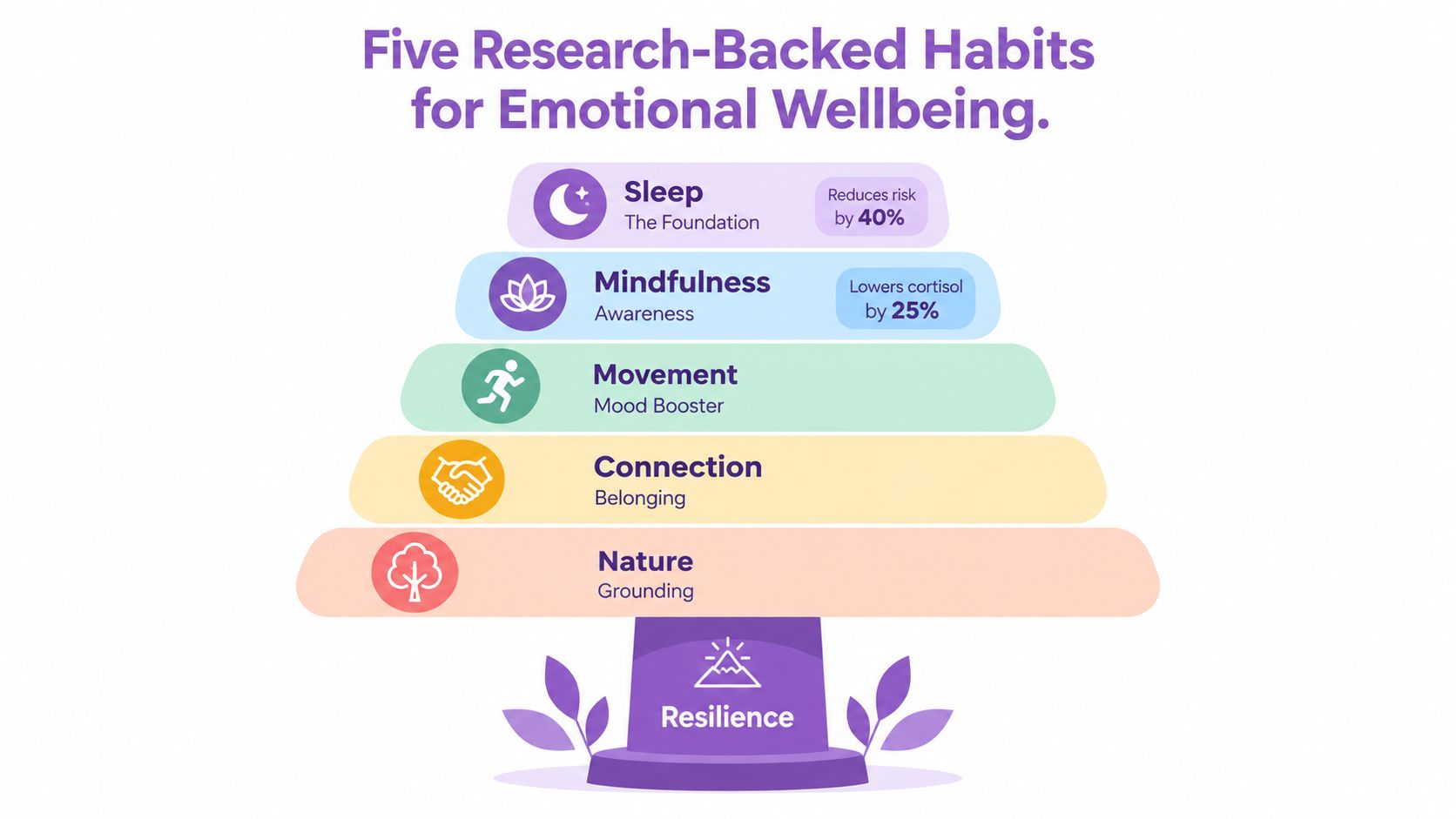
No single habit carries emotional wellbeing. Think of these practices as supports that work together, with each one small enough to fit around a normal schedule.
Mindfulness
Mindfulness means noticing the present moment without immediately trying to fix or judge it. It can be as brief as placing both feet on the floor, taking a slow breath, and identifying one sensation, one thought, and one emotion.
Try doing this before opening your inbox. The practice creates a small gap between an internal reaction and your next action, which can make stress feel more workable.
Sleep
Sleep gives the mind and body time to recover. A routine that protects sleep often supports every other habit because fatigue makes concentration, patience, movement, and social connection harder.
Choose one repeatable evening cue. Dim the lights, put your phone outside reach, or begin the same quiet activity before bed. The goal isn't a perfect night. It's making rest easier to recognize and repeat.
Movement
Movement doesn't have to mean a gym membership or an intense workout. A brisk walk, gentle stretching, dancing while dinner cooks, or taking the longer route through a building can shift your body out of a stuck, sedentary state.
Attach movement to something you already do. Walk during a voice call, stretch after brushing your teeth, or step outside after finishing a difficult task.
Connection
Social connection is health infrastructure, not an optional reward for people with extra time. The World Health Organization reports that one in six people worldwide is affected by loneliness, and loneliness is linked to about 100 deaths every hour; people who are lonely are twice as likely to become depressed, according to the global loneliness evidence summarized by Boston University School of Medicine.
Quality matters more than collecting contacts. Send one honest message, invite someone for a walk, or tell a trusted person that you've had a difficult week. A short exchange can be more nourishing than passive scrolling through many updates.
Aromatherapy
A scent can become a fast sensory cue for shifting pace. A 2023 NIH review found that exposure to multiple essential oils was associated with reduced stress hormones, greater parasympathetic stimulation, and lower negative-emotion ratings, with anxiolytic effects observed for lavender, sweet orange, marjoram, petitgrain, and other oils in the review of essential oils and psychophysiological effects.
That doesn't make aromatherapy a replacement for therapy or medical care. It makes inhalation a reasonable adjunct when you want a brief downshift, especially when a repeated scent becomes connected with breathing, rest, or sleep preparation.
For a practical guide to making small routines stick, see small habits that change your life. Pick one habit first. Consistency usually grows more easily from a modest action than from an ambitious plan you resent.
Daily Routines and a Five-Minute Shower Ritual
A routine works best when it follows the shape of your day instead of fighting it. Use this as a flexible template.
Morning, about ten minutes: Drink water, get daylight near a window or outdoors, and spend two minutes breathing slowly or setting an intention. Your intention could be, “I'll answer one difficult message after I've had breakfast,” rather than a vague promise to feel calm.
Midday, one minute: Stop before moving to the next task. Lower your shoulders, take three slow breaths, and ask what you need most, such as food, movement, quiet, or help.
Evening, five minutes: Use the shower as a transition between work mode and home mode. A shower steamer tablet dissolves on the shower floor and releases aromatic steam as water reaches it, so the routine doesn't require a bath or a separate block of relaxation time.
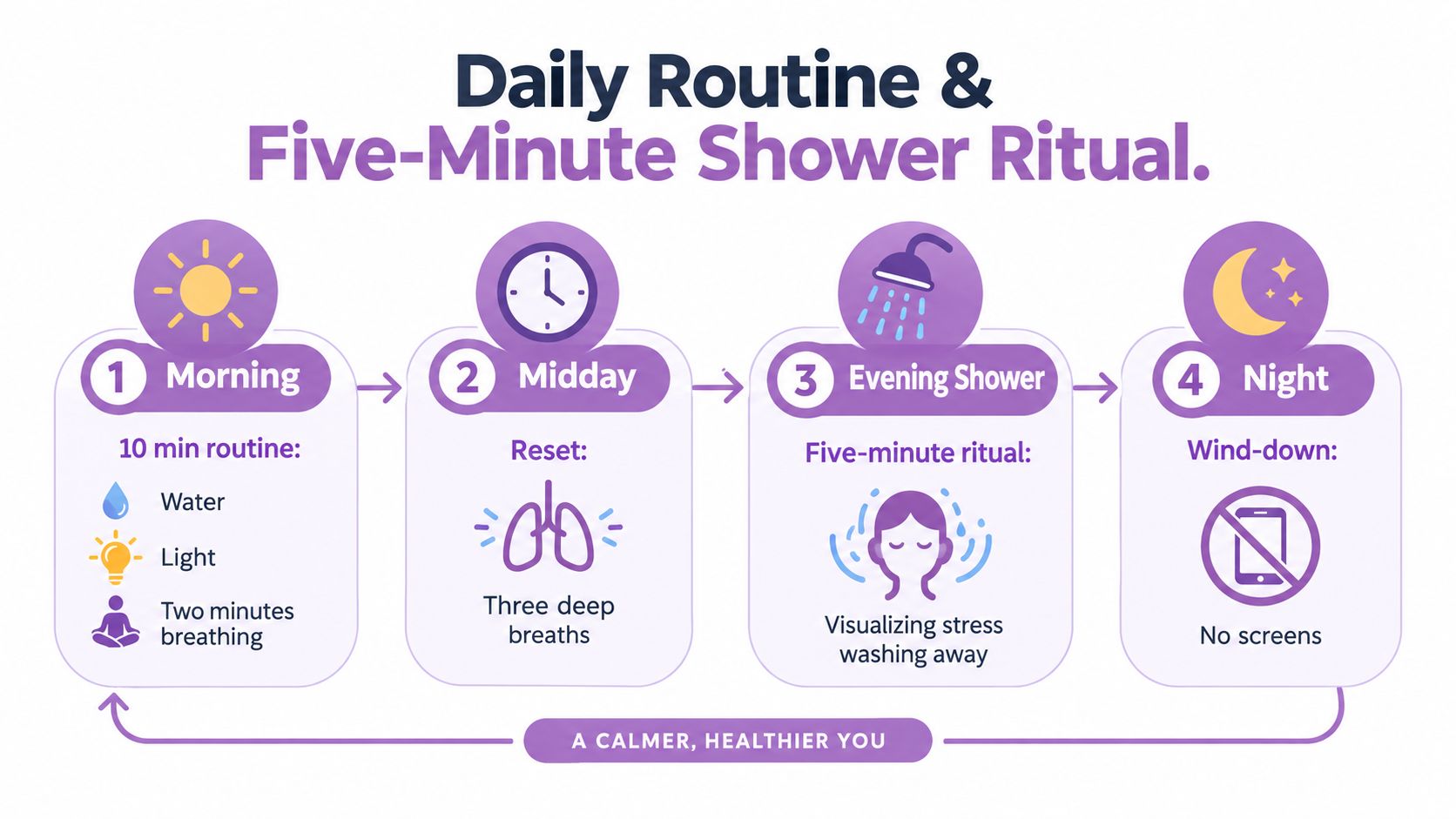
The five-minute shower ritual
- Choose the purpose. Pick an invigorating scent for a sluggish morning or lavender when you're preparing to wind down. Treat the choice as a quick check-in with your state, not another decision to perfect.
- Place the tablet safely. Put the steamer on the shower floor away from the direct water stream. This allows it to dissolve gradually rather than disappearing immediately.
- Slow your breathing. Inhale gently through your nose if comfortable, then lengthen the exhale. Let the shower mark a boundary between what happened earlier and what needs your attention next.
- Use the sensory cue. Notice the warmth, scent, and sound of the water. You're not trying to force happiness. You're practicing a deliberate downshift.
- Close the ritual. Before stepping out, choose one next action that supports the rest of the evening, such as preparing clothes, lowering the lights, or sending a message to someone you trust.
Human studies summarized in a 2021 review of essential oils and stress found that acute lavender exposure decreased salivary and serum cortisol. The review also describes essential oils as having their strongest evidence in anxiety reduction, with effects depending on context, so this ritual is best understood as short-term stress or sleep support.
You can read more about the practical setup in shower steamers as stress relief. Keep the routine comfortable, ventilate the room, and follow the product instructions. If you have asthma, allergies, pregnancy-related concerns, or sensitivity to fragrance, ask a qualified healthcare professional whether inhaled essential oils are appropriate for you.
At night, protect the transition you've created. Reduce stimulating content, keep the final part of the evening predictable, and allow the shower to be one cue among several rather than the entire solution.
Choosing a Wellness Gift That Actually Lands
Wellness gifts can feel personal when they match how someone lives. A shower-based set may suit a person who enjoys sensory rituals but doesn't have a bathtub, while a larger assortment makes more sense for someone who already uses shower steamers regularly.
The most useful question isn't “Which set looks impressive?” It's “Will this person use it in an ordinary week?”
| Recipient profile | Recommended set | Why it works |
|---|---|---|
| First-time user or occasion recipient | A themed six-pack, such as Purple, Men's, Red, or Teen | A smaller, defined selection makes it easier to try a scent-based routine without committing to a larger assortment. |
| Wellness devotee | An 18-pack assortment | More tablets support repeated use, refills, or a fuller gift presentation. |
| Someone who loves spa-style self-care | A gift-ready multi-scent set | The packaging and variety make the present feel experiential rather than like a practical household item. |
Presentation matters because the recipient should understand the gift immediately. Add a short note suggesting a use case, such as a morning reset or an evening shower, without implying that the product will solve serious distress.
Buying details can also reduce uncertainty. Cleverfy's catalog states a money-back guarantee, and its site states that qualifying U.S. orders of 50 USD and above receive free shipping. Check the current terms before purchasing, since store policies can change.

For more ideas organized around different recipients and occasions, browse wellness gifts from Cleverfy. A thoughtful gift gives someone an easy invitation to pause. It shouldn't create pressure to perform relaxation correctly.
When Self-Care Is Not Enough
Self-care is useful for ordinary strain, but it has limits. A stressful week that gradually improves with rest, support, and routine is different from low mood or anxiety that keeps interfering with work, relationships, sleep, or basic responsibilities.
Pay attention when a pattern lasts two weeks or more, when sleep doesn't recover, when you withdraw from things you once enjoyed, or when worry makes daily decisions and relationships harder. The duration alone doesn't determine what's happening, but persistence and interference are good reasons to speak with a professional.
You don't need to wait for a crisis. Start with a primary-care doctor, an employee assistance program, an available counselling service, or a licensed therapist. If you're unsure what kind of support fits, you can also use a trusted self-care blog from Healtsy for ideas while treating professional guidance as the appropriate next step when symptoms persist.
Aromatherapy, breathing, movement, and social routines can support short-term stress and sleep. The evidence summarized earlier describes them as adjuncts, not standalone treatments for depressive disorders. A shower ritual may help you get through the next few minutes more comfortably, but it can't assess your symptoms, address trauma, prescribe treatment, or replace a therapeutic relationship.
If you're in immediate danger, thinking about harming yourself, or unable to stay safe, contact local emergency services or a crisis service in your area now. Tell someone you trust and don't handle an urgent situation alone.
Choose one small habit this week, protect one relationship with a real point of contact, and write down where you'd seek help if your symptoms continued. Emotional wellbeing grows through repeated care, and asking for support is part of that care.
Cleverfy Beauty offers essential-oil shower steamer tablets in smaller themed gift sets and larger assortments that can fit a brief morning or evening routine. Visit Cleverfy Beauty to explore the available shower-based aromatherapy options and choose a simple sensory cue for your next pause.

