

Small Habits That Change Your Life, a 2026 Guide
You probably know the feeling. The day is already moving too fast, the bathroom light is harsh, the shower is running, and for a brief moment you've got a pocket of privacy before the next demand lands. That tiny gap is where small habits that change your life start, not in dramatic overhauls, but in repeatable moments you can meet again tomorrow.
The good news is that you don't need a perfect routine to change how your days feel. You need a small action, a steady cue, and enough repetition for your brain to stop treating the habit like a decision. A shower is one of the easiest places to do that because it already has a built-in start, a built-in stop, and a clear sensory boundary between one part of the day and the next.
If you want a gentle companion to that idea, Resty's piece on moments of calm advice fits the same mindset, calm comes from making space inside ordinary routines, not waiting for life to quiet down first.
Table of Contents
- Why Tiny Habits Can Reshape Your Days
- The Actual Timeline Behind Habit Formation
- Designing a Daily Anchor That Sticks
- Choosing the Right Scent for the Job You Want Done
- How a Shower Ritual Fits Into Real Lives
- A 30-Day Starter Plan You Can Begin Tomorrow
- Why Small Habits Stall and How to Restart
Why Tiny Habits Can Reshape Your Days
A small habit works because it fits into a real day. You can do it when you are tired, rushed, or only half paying attention, which is exactly when large plans tend to fall apart. The 2010 habit-formation study followed 96 adults for 12 weeks and found that average automaticity peaked around 66 days, with a wide spread from 18 to 254 days depending on the person and the behavior (Wiley study). In plain language, what feels trivial on day one can become something you do with far less internal debate later on.
Repetition does the heavy lifting
Each repeat lowers the effort of starting. You stop weighing every action from scratch and begin to move when the cue appears. A one-minute change, like replacing phone scrolling with one slow breath under the steam, can matter more than a grand plan you only manage once.
Practical rule: if the habit is hard to start, it is probably too big, too vague, or attached to the wrong cue.
The larger point is simple. Habits do not need to feel impressive to work. A shower ritual can become the moment you reset your body, shift your mood, or mark the end of work, because the action is easy to repeat in the same place and at the same time. For another calm, routine-based angle on building these moments, the idea of making relaxation part of everyday life shows up clearly in this guide to moments of calm advice and how busy days can still hold moments of calm when scent and routine are used deliberately.
The compounding effect is quiet, not dramatic
People often wait for a big breakthrough and miss the value of the repetition itself. The habit is the point. When a tiny action happens in the same context again and again, it starts to feel like part of who you are, and that identity shift often keeps the behavior going after motivation fades.
That is also why the rest of this guide leans on showers and scent. A shower already happens in a stable place, at a stable time for many people, which makes it a strong anchor for repeatable self-care. The evidence on habit timelines follows.
The Actual Timeline Behind Habit Formation
The hardest habit myth to shake is the idea that a small action should settle fast if it is small enough. The research paints a slower, steadier picture. A 2024 systematic review and meta-analysis of 20 studies with 2,601 participants found that health-related habits usually take 2 to 5 months to form, with individual estimates ranging from 4 to 335 days (systematic review). That is a long way from the popular 21-day claim, which keeps spreading because it sounds tidy, not because the research supports it.
What the average means
The useful takeaway is not a fixed deadline. It is that repetition in the same context slowly makes the action easier to start, then easier to repeat. A 2010 study found an average time to peak automaticity of 66 days, but the spread from 18 to 254 days shows how much habit speed changes with the behavior and the person (Wiley study). A simple action you do every day usually settles sooner than a complex plan you only manage once in a while.
| Claim or Study | Reported Timeline | What It Means |
|---|---|---|
| 2010 habit-formation study | 66 days on average | Repetition in a stable context can make a simple behavior feel automatic over time |
| 2010 habit-formation study | 18 to 254 days range | People and behaviors differ a lot, so there is no universal finish line |
| 2024 systematic review and meta-analysis | 2 to 5 months typical | Habit formation usually takes longer than the 21-day myth suggests |
| 2024 systematic review and meta-analysis | 4 to 335 days range | Context, consistency, and the behavior itself shape how fast automaticity builds |
A missed day does not wipe out progress. The better question is whether the cue still appears and the routine is simple enough to return to without a long restart. That is why environmental design matters so much. It removes extra decisions, the same way a well-placed hook keeps a coat from ending up on the floor.
If you have seen advice from habit thinkers like Wendy Wood, James Clear, or BJ Fogg, the common thread is clear. Stable context helps. Identity gets reinforced. Tiny behaviors are easier to begin and easier to repeat. The timeline above gives the realistic frame, and it also explains why a shower ritual can work so well.
Designing a Daily Anchor That Sticks
A good anchor is specific enough that your brain does not have to improvise. The shower works well for that because it already has a clear start cue, a fixed place, and a short window where you are not juggling screens, errands, or other people's needs. Steam also helps scent spread quickly, so the shower can hold a tiny routine without asking for extra effort.
Start with one movement and let it stand for the whole ritual. Turn on the water, place a steamer where it belongs, and make that the signal that the habit has begun. That is habit stacking in a form you can repeat without much thought. For a fuller explanation of the method, see the power of self-care habit stacking.
Cue, routine, reward in one small loop
The cue is the shower turning on. The routine is the single action you choose, maybe setting down a scented tablet or taking one slow breath before you reach for your towel. The reward is the sensory shift, a calmer body, a clearer head, or an easier handoff between parts of the day.
The anchor should be easy enough to start in under five seconds.
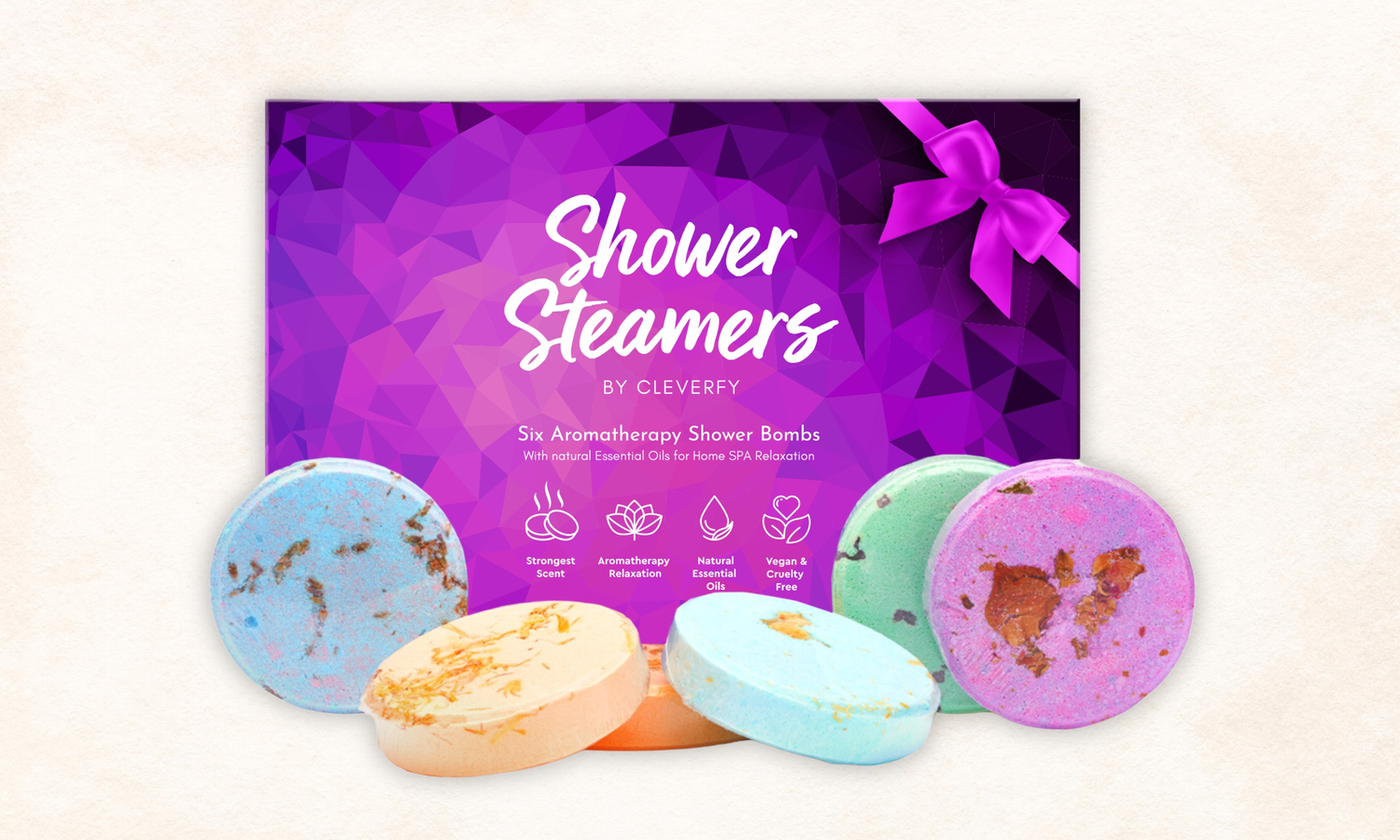
That is why a product like Cleverfy Purple Gift Set of 6 Shower Steamers can fit this pattern naturally. The set includes Lavender, Watermelon and Vanilla, Grapefruit and Coconut, Menthol and Eucalyptus, Orange, and Peppermint, so the ritual can stay simple while still giving you a few scent options to match different mornings or evenings. The point is not to turn shower time into a big self-care event. The point is to make one repeatable cue easy to notice and easy to keep.
Make the trigger obvious
If the steamer lives in a drawer, the habit has to survive extra friction. If it sits where you can see it at shower time, the choice gets simpler. That is the design win here. The routine rides on something you already do, instead of asking you to create a brand-new block in an already crowded day.
The same logic shows up in the Essentia Perfume cologne guide, where scent is treated as part of a daily cue, not as decoration. That framing matters because small habits last longer when the trigger is obvious, the action is brief, and the reward is easy to feel.
Choosing the Right Scent for the Job You Want Done
Scent works best when it matches the outcome you're trying to cue. A calming blend can help a night shower feel like a landing strip, while a sharper scent can make a morning rinse feel more alert and purposeful. The mistake people make is treating fragrance as decoration instead of a prompt for a specific routine.
Match scent to the outcome
| Scent Category | Habit Goal | Best Time of Day |
|---|---|---|
| Lavender, eucalyptus | Wind-down, lowering stimulation | Evening |
| Eucalyptus, peppermint | Congestion relief, clearer breathing | Cold season or allergy flare-ups |
| Citrus, grapefruit | Morning momentum, a brighter start | Morning |
| Rosemary-mint style profiles | Midday reset, sharper focus | Afternoon |
The link between scent and habit gets stronger when the fragrance feels easy to tolerate in a shared bathroom. Strong scents can be useful for one person and overwhelming for another, so it helps to think in terms of daily use, not just first impressions. If the scent is too intense, it may end up as an occasional luxury instead of a dependable cue.
The internal guide on the best essential oil scents for every mood is useful here because it treats scent as a functional choice, not just a nice smell. That's a better frame for a habit, since the goal is to make the cue emotionally and physically recognizable.
Keep the ritual comfortable for real life
Skin sensitivity matters too. If someone in the household reacts strongly to fragrance, the habit won't survive well in the long run, no matter how good the intention is. A good anchor is one you can repeat without negotiation, so matching scent strength to the bathroom, the season, and the people using it is part of the design.
Morning energy, evening wind-down, and a midday reset are different jobs. Once you stop asking one scent to do everything, the ritual becomes easier to trust. That same principle shows up differently depending on who's using the shower, which is why the next section looks at real-life schedules instead of ideal ones.
How a Shower Ritual Fits Into Real Lives
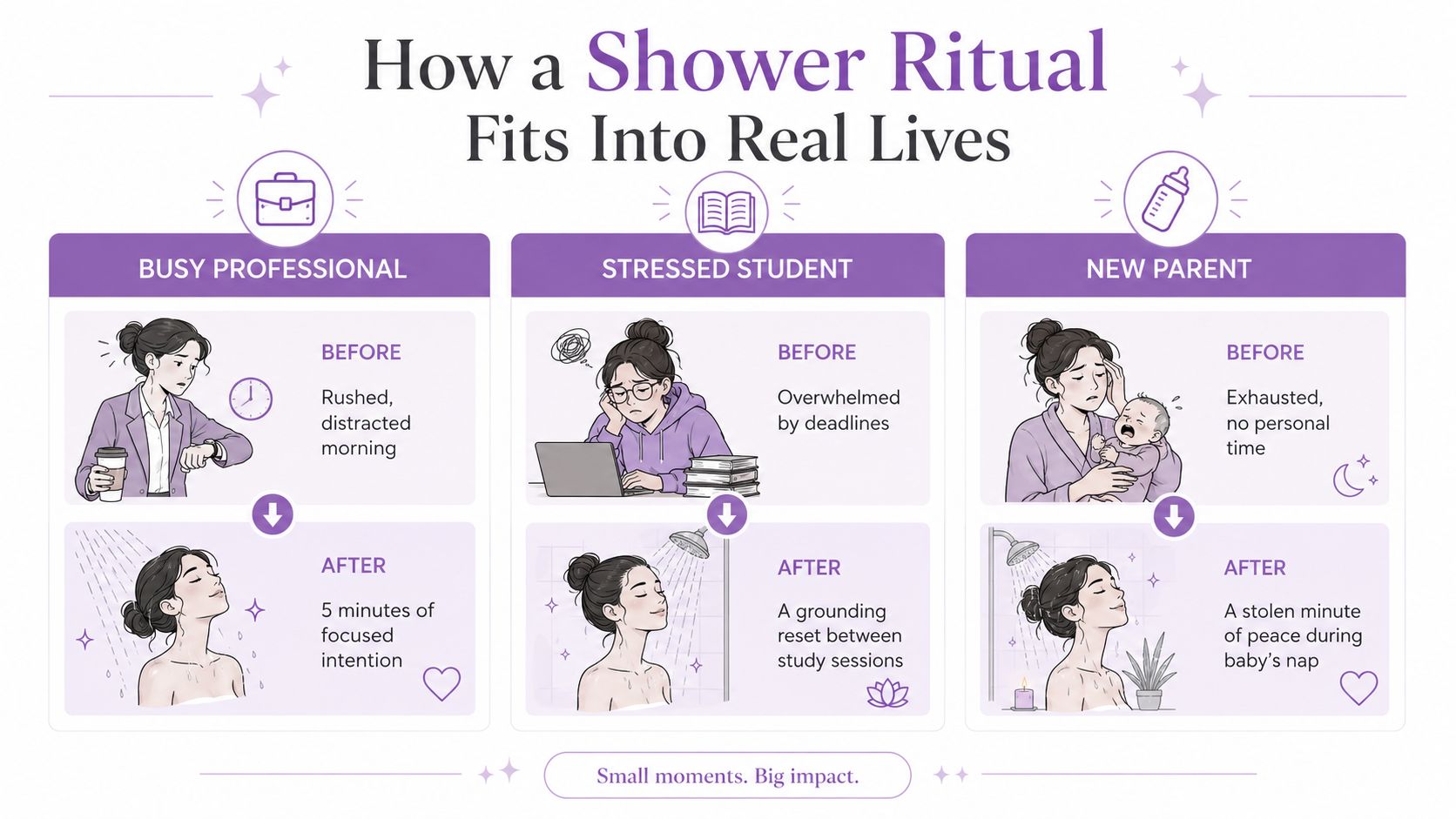
A habit only matters if it can survive a real Tuesday. That means the same shower ritual has to work for a professional coming home drained, a student trying to reset between assignments, and a new parent who barely has time to lock the bathroom door. The shape changes, but the principle stays the same, the shower is the cue because life already put you there.
Three different lives, one repeatable frame
A busy professional might treat a 10-minute evening shower as the hard stop between work and home. The ritual is simple, turn on the water, place in a calming steamer, and let the scent signal that work is over. The point isn't luxury, it's transition.
A stressed student may use the shower as a pre-study reset. A focus scent before a review session gives the brain a repeatable start cue, so the shower becomes part of the study rhythm instead of a random break. That tiny consistency can help the mind know what comes next.
A new parent needs something much smaller. A 90-second shower with a congestion-clearing scent can still count as a real ritual because the habit lives inside a tight window, not outside the day. The win is not perfection, it's claiming one quiet minute that belongs to them.
For practical usage guidance that keeps the ritual grounded, the internal page on how to use shower steamers is a useful reference. It reinforces the point that the habit should be easy to repeat, not complicated to remember.
Why this works across schedules
The shower fits different lives because it doesn't ask for extra time to begin. It borrows time that already exists and gives it a cleaner purpose. That's the heart of the method, tiny behaviors become dependable when they sit inside ordinary routines, not beside them.
People often overcomplicate things. They think the habit has to be long to count, but the research above says repetition and context matter more than intensity. The next section turns that into a concrete 30-day plan, so you can start tomorrow without overthinking it.
A 30-Day Starter Plan You Can Begin Tomorrow
A month is long enough to build a pattern and short enough to feel manageable. The goal here isn't to become a different person by Friday. It's to give one small ritual a fair chance to repeat in the same place until it starts to feel normal.
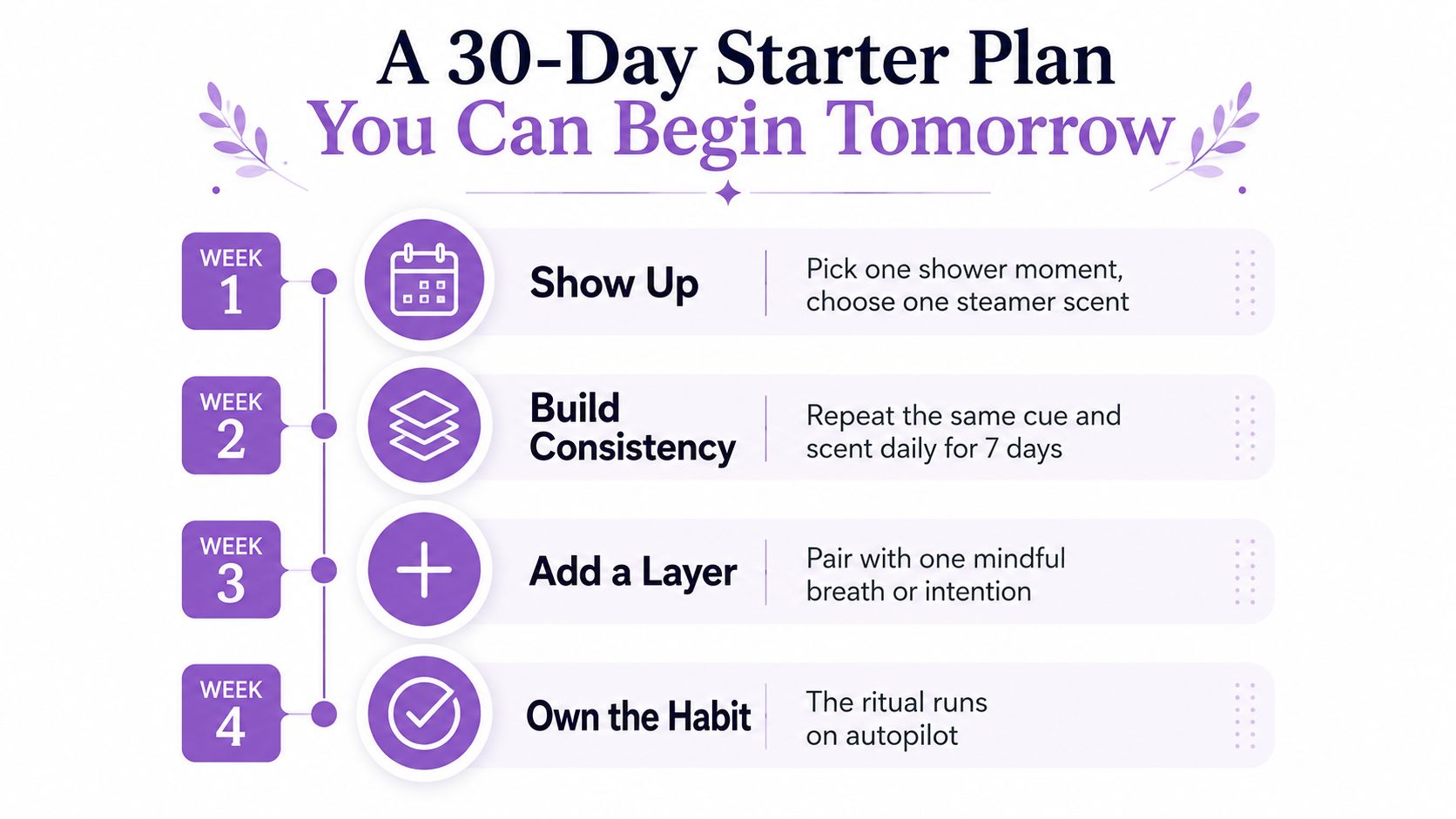
Week 1 show up
Pick one shower moment, morning or night, and choose one scent. Use it without judging whether it feels “working” yet. The only job this week is to connect the cue with the action.
Week 2 repeat the same cue
Keep the same time, same bathroom, same scent. Add one breath at the end of the shower so your body gets a clear finish line. That little pause helps the reward land instead of disappearing into the rush.
Week 3 add one layer
Add a second scent for a different time of day if you're ready, or keep the same scent and add a short intention. The key is not to increase effort, just to make the routine more recognizable. A morning citrus shower and an evening lavender shower can live side by side without becoming complicated.
Week 4 review honestly
Ask what stuck, what felt forced, and what you used. If you're looking at pack sizes, let your behavior decide, not your hope. A 6-pack makes sense when you're still testing consistency or using the ritual only a few times a week, while a larger 18-pack assortment fits better when the habit has become a regular part of life and you want more rotation without changing the structure.
Simple checkpoint: buy for the routine you practice now, not the one you wish you already had.
That honesty matters because a habit shouldn't depend on buying more than you'll use. If the ritual becomes a reliable part of your day, the right pack size is the one that matches that reality. If not, start smaller and let the cue do its work first.
Why Small Habits Stall and How to Restart
You reach for the shower steamer, then skip it for three days. That usually means the habit was too hard to notice, too awkward to start, or too easy to leave for later. Small habits rarely collapse because the idea was wrong. They stall when the cue is weak, the friction is high, or the routine asks for more willpower than the moment can spare.
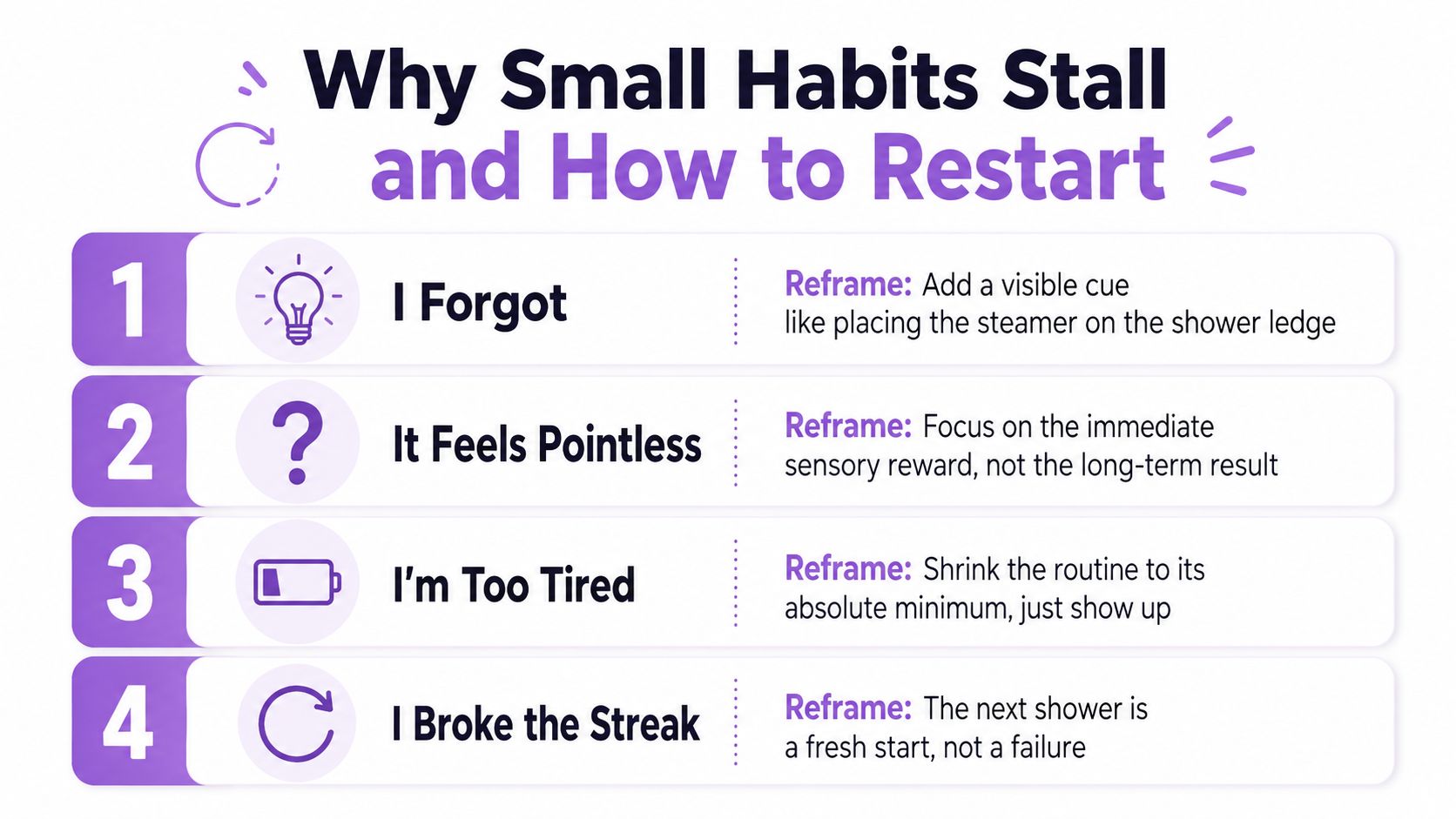
Common stalls and cleaner resets
- I Forgot. Put the steamer where your eyes land first, such as the shower ledge.
- It Feels Pointless. Pay attention to the immediate smell, warmth, and pause, not the long outcome.
- I'm Too Tired. Shrink the ritual to one breath and one action.
- I Broke the Streak. Treat the next shower as a restart, not a test.
Restarting is usually a design problem. If you forgot, the environment needs to do more of the remembering. If you felt tired, the habit was asking for too much on that day. If the ritual felt flat, a different scent can make the cue easier to notice again.
A rotating set helps once the routine is already familiar but your attention starts to drift. The goal is not novelty for its own sake. It is to make the habit easy to return to. Misses are useful because they show where the setup needs help.
Patience matters here. Habit research suggests that automaticity often builds slowly, with wide variation from person to person, as shown in the Wiley study and the systematic review. So if your tiny ritual still feels clunky after a few weeks, that does not mean it is failing.
Start with the smallest possible version of one habit today, tie it to the shower cue, and notice only whether you restarted after a miss. A modest ritual grows through repetition, like a path that becomes easier to walk each time you use it.

